Fire management byelaw - owner guidance
Cairngorms Fire Management Byelaw: Guidance for land and property owners, managers and occupiers
Contents
Background…………………………………………………………………………………………………2 Purpose…………………………………………………………………………………………………….2 The role of land & property owners, tenants and occupiers………………………………2 The Park Authority’s Role…………………………………………………………………………….3 Exemptions — by type of property…………………………………………………………………4 Domestic properties………………………………………………………………………………..4 Holiday accommodation…………………………………………………………………………..5 Licenced caravan & camping sites…………………………………………………………….5 Mountaineering Club huts or similar……………………………………………………………6 Bothies……………………………………………………………………………………………………6 Organised events and organised groups………………………………………………………7 Providing evidence of the granting of an exemption……………………………………….9 Stoves…………………………………………………………………………………………………….10 Gas barbecues……………………………………………………………………………………….10 Explaining why some fires or barbecues are allowed…………………………………..11 Fires & barbecues outside the period the byelaw applies……………………………..11 Reporting of fires…………………………………………………………………………………….12 Fire reporting matrix………………………………………………………………………………..13 Further advice and information………………………………………………………………….13 Appendix 1: Cairngorms Fire Management Byelaw……………………………………..14
Background
Following an extensive public consultation process the Cairngorms National Park Authority received approval from the Scottish Government to introduce a fire management byelaw and this will come into force on 1 April 2026. Thereafter the byelaw will operate on a seasonal basis from 1 April to 30 September inclusive each year. While it is recognised that there is a risk of fire at other times of year this seasonal approach reflects significantly higher visitor numbers in spring / summer combined with more frequent warm weather that can encourage more people to undertake activities such as camping or barbecues and so the byelaw prioritises restricting the use of fires and barbecues at this time.
Purpose
The Cairngorms Fire Management Byelaw (hereafter referred to as “the byelaw”) places restrictions on people having fires or barbecues in the National Park primarily in order to reduce the risk of wildfires being started by those activities. However, the byelaw also recognises the need to allow fires to be permitted for some purposes or for fires to be permitted in certain locations and a number of definitions and exemptions are included in the byelaw to detail when this is the case. To provide further detail on those circumstances, this document has been produced as a straightforward guide to the exemptions and who has the power to use or permit the use of those exemptions as well as providing further advice or guidance where considered appropriate.
The role of land & property owners, tenants and occupiers
The byelaw imposes certain regulations on members of the public in relation to the use of fire on property where they don’t have express permission. However, it does not take away any of a landowner’s existing powers to manage their land in the way that they consider appropriate to their own circumstances. Landowners, or tenants where their lease permits it, continue to have the right to decide if or when to use fire for land management purposes. In particular it should be noted that this byelaw does not have any direct impact on activity such as muirburn which is covered by separate national legislation.
Owners, tenants or occupiers also have the ability to work with individuals or with groups who wish to undertake activities on their land and which may include the use of fires or barbecues. This authority is expressed within the wording of the byelaw through a number of exemptions. The Cairngorms Fire Management Byelaw defines three groups of people who have powers either to have a fire or barbecue or to permit others to do so:
- Landowners – where a landowner is defined as “the owner of any land or building within or connected to the National Park.”
- Occupiers – who are defined as “any person who is occupying a dwellinghouse or property with the consent of the landowner.”
- Tenants — who are defined as “the tenant of any land within the National Park leased or let to such tenant under a lease.”
In practical terms this means that, in the case of domestic residences, these rights will apply not only to owners, but to the majority of residents as long as they are sharing the property with the consent of the owner (eg a house share) or are renting the property as either a domestic home or as a holiday residence as long as there is some form of let or lease agreement in place.
The Park Authority’s Role
Using the powers available to it, the Cairngorms National Park Authority took on the lead role in consulting on, developing and, with approval now received from the Scottish Government, introducing the byelaw. Following this, the Park Authority has been granted the status of a “Specialist Reporting Agency” which allows it to submit cases direct to the Crown Office and Procurator Fiscal Service who then makes an independent decision on whether or not to take the case to court or whether any other action is deemed appropriate when taking into account the circumstances that apply in that particular case.
Fundamentally, the intended outcome of the fire byelaw is to reduce the risk to the people, wildlife and habitats of the National Park — with a number of actions to reduce the number of fires or barbecues an important element of achieving this: -
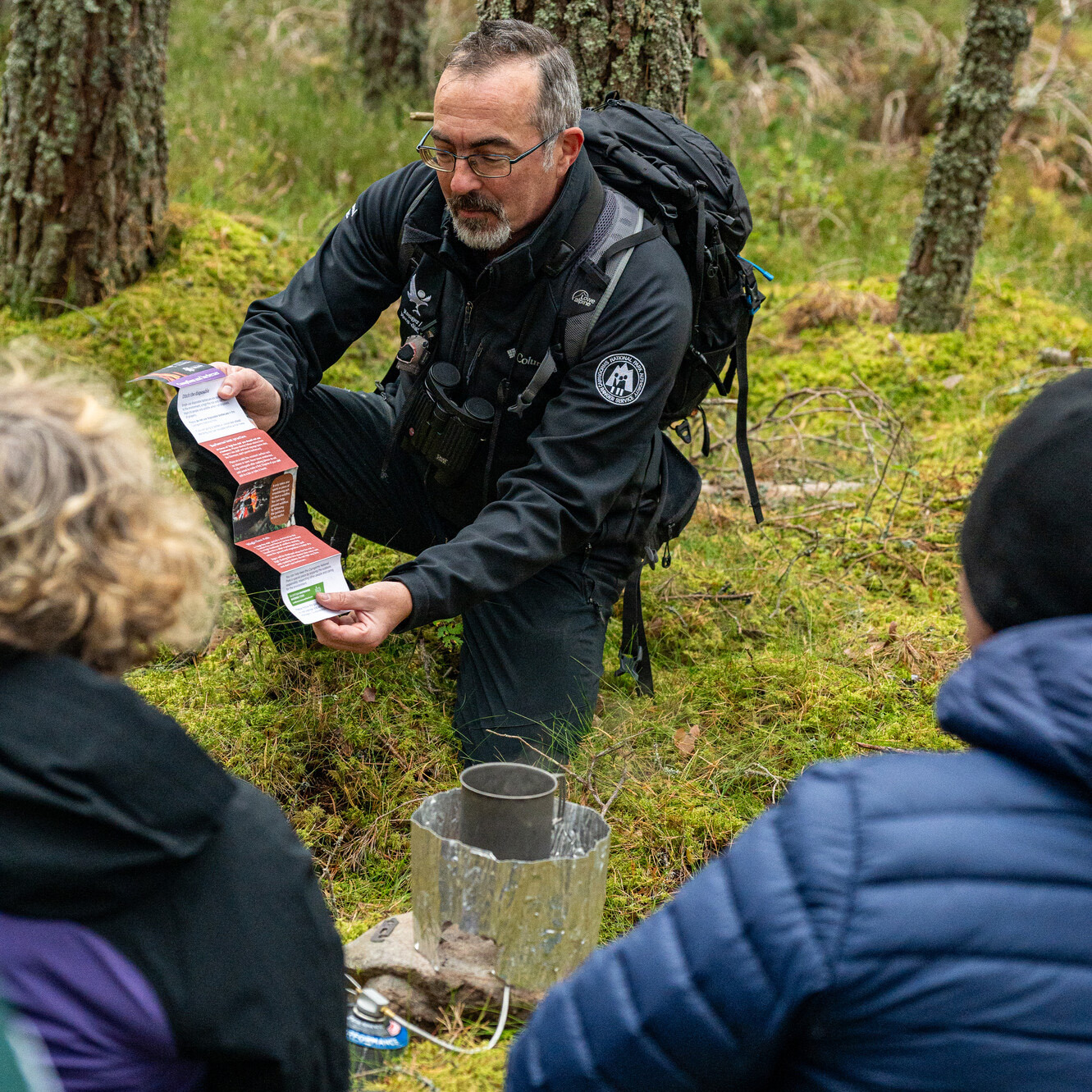
- The Park Authority’s ranger service will undertake patrols across the National Park with a particular emphasis on locations known to be used for recreational fires and barbecues.
- The emphasis in all ranger patrols engagements will continue to be to inform and advise people about the risk, particularly from recreational fires or barbecues and the existence of the byelaw with the intention of getting any fires that are encountered extinguished.
- Where extinguishing a fire is not possible due to people refusing to comply with the advice given, Park Authority rangers have the power to and when necessary will undertake enforcement action.
- Where considered beneficial to do so the Park Authority’s ranger service may undertake patrols jointly with rangers from partner ranger services as this increases the opportunities to undertake enforcement action if this is required.
The byelaw allows for the fact that there will be circumstances where people should legitimately be able to have a fire or barbecue, and these circumstances are recognised through a number of exemptions. Those exemptions are based around the principle of permission being given by a recognised person who has the right to do so. However, it is not considered appropriate for the Park Authority to make decisions on individual requests as there will be many local factors that may influence whether it is appropriate or reasonable for permission to be granted and what if any conditions might be included. The ultimate responsibility for deciding whether or not to grant an individual request for an exemption rests with the landowner or where appropriate the tenant or occupier not with the Park Authority. In this context the Park Authority’s role is therefore to:
- Providing advice to landowners, tenants and occupiers on exemptions and their use. This document is one element of the Park Authority’s ways of providing that advice.
- Providing advice to members of the public on exemptions where required.
- Distributing Scottish Fire & Rescue service warnings and further advice during high fire risk periods to help landowners and others make informed decisions on whether the use of any exemption is appropriate at that time
- Providing ongoing advice in the light of any new or unforeseen circumstances that arise – this will primarily be done through an FAQ section on the Park Authority’s website.
Exemptions – by type of property
Domestic properties
As long as it is under the control of a person or persons who can be defined as the landowner, tenant or occupier of the dwellinghouse, section 3(a) of the byelaw permits people to have a fire within the curtilage of a private dwellinghouse with section 5(a) giving equivalent permission in relation to barbecues. In this context the curtilage can be considered to be any private garden area. This permission is qualified by the responsibility for the fire to be under control “so as to safeguard against damage or danger to any person, wildlife, livestock, building, structure, tree, shrub or vegetation.” In practical terms this gives any residents the right to have a fire or barbecue on their own property if it is done safely.
Holiday accommodation
As described for domestic properties above, sections 3(a) and 5(a) of the byelaw allow the occupier of a dwellinghouse to give permission for a fire or barbecue. Under the definitions contained within the byelaw “dwellinghouse” explicitly includes properties used for short term lets under the Civic Government (Scotland) Act 1982 (Licensing of Short-term Lets) order 2022 and “Occupier” means any person who is occupying a dwellinghouse or property with the consent of the landowner. Any person renting a holiday property where there is an agreement or contract in place is therefore deemed to be an occupier. Unless the terms and conditions that are accepted as part of the booking of the holiday property prohibit or restrict the use of fires or barbecues the person or persons occupying the property can effectively give themselves permission to have a fire or barbecue. As with Domestic Properties above there is still a requirement for any fire or barbecue to be under control for any permission to be considered valid.
Licenced caravan & camping sites
Section 3© permits fires and section 5(b) permits barbecues as long as they are wholly contained “In a licensed caravan site so as to safeguard against damage or danger to any person, wildlife, livestock, building, structure, tree, shrub or vegetation and has permission from the owner of the site.” The specific reference to licenced sites means only those sites issued by the local authority under the Caravan Sites and Control of Development Act 1960 have this exemption in place. This avoids the situation where anyone camping in other locations could claim that as they are camping the location they are in can be considered a campsite and subsequently covered by this exemption. As stated in the byelaw, fires and barbecues can only allowed with “permission from the owner of the site”. This permission may be given following a specific individual request but could also be given through the terms and conditions for the use of the site that are accepted as part of a booking. As with Domestic Properties above there is still a requirement for any fire or barbecue to be under control for any permission to be considered valid.
Mountaineering Club huts or similar
A number of mountaineering clubs have club huts in the National Park, and these are often let to other clubs or organisations as well as being used by club members. Similar situations may also apply to properties owned and used by other organisations. Typically, these will be considered as hostels and as such are not likely to be registered as short term lets under the Civic Government (Scotland) Act 1982 (Licensing of Short-term Lets) order 2022 so the circumstances described above for holiday accommodation will not directly apply.
In the case of club members it is likely that use of any hut belonging to the club will be included as benefit of membership and therefore use of the hut would be deemed to be taking place with the owners consent (or lease holders consent if the club lease the hut) and the user would be classed as an “occupier” under the definition within the byelaw. When occupying the property, club members can therefore effectively give themselves permission to have a fire or barbecue.
Where a club hut is used by members of a club other than the club owning or leasing the hut it is likely that a booking has been made with some form of contract in place and therefore the hut is being occupied with the owner or tenant’s consent. Again, the user would be classed as an “occupier” under the definition within the byelaw and could effectively give themselves permission to have a fire or barbecue. The exception to this would be where the terms and conditions that are accepted as part of the booking contract exclude the use of fires or barbecues. As with Domestic Properties above there is still a requirement for any fire or barbecue to be under control for any permission to be considered valid.
Bothies
While the term “bothy” is often used for many different property types including staff accommodation or holiday properties, for the purposes of the byelaw there is a specific definition in place and those not falling within this definition would require to be treated as domestic properties or holiday accommodation where any exemptions were being considered. Essentially the byelaw definition only includes open / mountain bothy type properties with the precise definition being: — “A building of no more than two storeys which: i. Does not have any form of mains electricity, piped fuel supply and piped mains water supply. ii. Is 100 metres or more from the nearest public road (within the meaning of Section 151 of the Roads (Scotland) Act 1984). iii. Is 100 metres or more from the nearest habitable building.”
In the case of bothies, there is a specific exemption — section 3(b) that permits fires “In a fireplace in a bothy so as to safeguard against damage or danger to any person, wildlife, livestock, building, structure, tree, shrub or vegetation.” However, there is no equivalent exemption for barbecues (which would be used outside a bothy rather than indoors in a fireplace) meaning barbecues are still prohibited around bothies.
Organised events and organised groups
While the byelaw does not include any exemptions specifically for organised groups or events, it is recognised that the degree of organisation with such usage is different from more spontaneous or casual use under Scottish Outdoor Access Code principles. As such there are mechanisms included within the byelaw that allow those using land with specific permission to be permitted to have fires or barbecues where the landowner or tenant considers this appropriate. Whether a tenant has the right to grant permission is not governed by the byelaw itself but will instead be subject to the individual terms of a tenancy agreement which will typically clarify which party has rights in relation to a much wider range of activities and not just fires or barbecues.
Section 3 of the Scottish Outdoor Access Code which covers “Exercising access rights responsibly” indicates that people should take extra care if organising a group, an event or running a business. This includes contacting land managers where elements such as educational visits are concerned and “obtaining the permission of the relevant land managers if your event needs facilities or services”. The vast majority of organised events will require some “new or temporary facilities and services” as defined in section 3.60 – and many group camps where facilities such as toilets will likely need provided could have similar requirements eg toilets or waste facilities. As such, organisers will likely be engaging with landowners in advance of their visit anyway and further guidance as to how requests to include fires or barbecues might be considered is given below.
Events
It is particularly uncommon for an event to take place without some form of facilities or services being required even if these are as simple as a start banner or signage for a participation event or toilets or litter bins for spectators at other events so it is normal for organisers to have to make contact with landowners or managers. In responding to such requests from event organisers it will be common practice for some form of contract to be put in place between the landowner and the organiser and this would be the ideal place to detail any particular information around fires or barbecues.
A contract between a landowner / tenant and an event organiser is likely to mean the organiser could be considered the occupier of the property for the period for which the event takes place. However under the terms of the byelaw the occupier of a property is only entitled to have a fire or barbecue if done safely “and if an occupier has the written permission of the appropriate landowner or tenant” — defined in section 3(d) in relation to fires or 4© in relation to barbecues. It will therefore be necessary for any organiser wishing to have a fire or barbecue to have explicit permission for this rather than simply relying on a contract that considers them to be the occupier of the property for the duration of the event.
Organised Groups
In considering the scope of the byelaw it was recognised that there may be times where permitting a group to have a fire or barbecue may be reasonable. In particular, the Park Authority recognises the benefits that can be derived from educational visits as well as commercially operated trips that include elements such as “bushcraft” and teaching participants about the safe use of fire. Other groups particularly those like Scouts or other youth organisations are also considered to bring wider benefits in terms of greater understanding of the countryside and nature as well as mental health benefits for participants. As such, the Park Authority would encourage landowners to respond positively to such requests where it can be demonstrated that this can be done safely.
In recognition of the fact that the Park Authority will not have detailed knowledge of all the local circumstances that will influence the level of risk in any given area at a given time, the byelaw purposely gives the power to make decisions on what to permit to the appropriate landowner or tenant. This is also designed to allow the landowner or tenant, when granting permission to incorporate any mitigation or safety measures such as: -
- The precise location(s) where a fire might be permitted
- What, if any, safety precautions might be required such as, access to water sand etc to douse fires
- Any additional requirements such as qualifications or firefighting equipment
- Ensuring access to the site is protected to allow for any emergency access should an incident occur
Outdoor & Woodland Learning (OWL) Scotland is a national membership organisation dedicated to increasing the use of Scotland’s outdoor and woodland environments for learning. OWL have produced a fire guidance document, seen by many as the industry standard for groups wishing to use fire as part of their programme. It is endorsed and used by members of the Scottish Countryside Rangers Association – the professional membership body for Rangers in Scotland. Landowners and property managers seeking further guidance on working with groups and what broader advice they might give to complement any local requirements are recommended to consider using this guidance.
While not in itself a safety factor, careful consideration of the proximity and suitability of an area in relation to other public activity should be considered. While exemptions will permit fires in approved circumstances, the details of any arrangements are unlikely to be known to the wider public which could lead them to believe it is appropriate for them to also have a fire or barbecue if they see others doing so. Dedicated locations, particularly for group camps that are away from and not too visible from the passing public are likely to make it easier for landowners and others to manage this.
Commercial Operators
Many commercial operators will effectively be a subset of the above classification of “group” as those the clients they are working with or hosting will often constitute a group. However, particularly with small group camping activities that could still fall within the SOAC definition of wild camping ie “lightweight, done in small numbers and only for two or three nights in any one place” an operator may be able to go about their normal business without engagement with the landowner. While able to undertake most activity under SOAC rights, if done responsibly there be some who do wish to include some form of fire within their programme and as such may need to seek permission. The Park Authority would encourage landowners to respond positively to such requests where it can be demonstrated that this can be done safely as there are likely to be longer term benefits through the learning that people get from this type of experience.
Providing evidence of the granting of an exemption
To guard against opportunists claiming to have been given such permission when they have not, the byelaw specifically defines that this permission must be in writing so that proof of permission can be requested when required. For this purpose, “written” can be considered to include electronic messages such as e‑mails or electronic versions of letters, agreements or contracts sent as attachments.
The byelaw does not prescribe how written permission should be provided and as such gives some flexibility to landowners or tenants to provide this in a way that suits their own requirements. In particular this will allow landowners or tenants who choose to do so to give permission for multiple visits at the one time. This may be a useful approach for partner organisations who visit regularly or multiple times in a year. Irrespective of whether the byelaw applies or whether any regular exemption is in force it will normally be necessary to prohibit fires at times of higher fire risk and so any agreement should reflect the fact that permission may only be valid at certain times.
As providing permission for an activity on their land will be considered a standard element of the management of their property, there is no requirement for landowners or tenants that grant permission for a fire or barbecue to notify the Park Authority of any permission they have granted. However, those organisations or groups that are granted permission should be advised to bring evidence of permission with them as they may be approached by people such as Park Authority rangers or Police or Scottish Fire & Rescue Service officers involved in fire management activities.
Stoves
In considering the introduction of the byelaw it was recognised that many people will undertake multi day trips in or through the Cairngorms, backpacking, bikepacking, canoeing etc and that a means of cooking food would be required for comfort and safety. In order to allow this in the way that was considered lowest risk, the use of cooking stoves is therefore covered by an exemption in the byelaw. However, this exemption is not designed to allow solid fuel stoves such as those used for heating some vehicles or tents. Section 4 of the byelaw therefore states that “These byelaws shall not prevent the use of a camping stove manufactured as a camping stove or cooker (excluding any wood or coal-based system), provided it is used in such a manner as not to cause danger of, or damage by, fire.”
While the use of the types of solid fuel stoves typically used for heating is not covered by the byelaw exemption, the exemptions allowing use with the consent of a landowner described above would still apply and so for example organised trips / groups involving camping in a “hot tent” could still take place where such permission is given.
Gas barbecues
While each of the exemptions described above restrict the use of barbecues within the byelaw period, it should be noted that these restrictions do not apply to gas barbecues as long as these are used appropriately. Section 6 of the byelaw states that “These byelaws shall not prevent the use of a gas barbecue, provided it is used in such a manner as not to cause danger of, or damage by, fire.”
Explaining why some fires or barbecues are allowed
While there is a risk-based rationale for why the byelaw allows permission to be given for some fires or barbecues it is expected that many members of the public will observe others having a fire and may query why they cannot do so as well. If responses to those queries can emphasise the different circumstances that apply this is likely to be helpful in ensuring compliance — particularly if there can be an element of consistency where responses may be given by multiple partners. To assist it is recommended that any response provided in relation to a query should emphasise:
- These are events / visits planned in advance so the participants can be directed to suitable sites which have been identified as being low risk.
- Additional safety measures are or can be put in place as part of the arrangement.
- Landowners are aware in advance of what is happening and where it is happening so can have staff and / or equipment available if required — which differs significantly from the wider public taking access on a more casual basis.
- Having prior engagement with and contact details for those attending can allow landowners to notify those involved on any changed circumstances that mean a fire is no longer appropriate – for example if a high fire risk warning has been issued.
- Organised groups will typically be led by people who have undergone more formal training and / or have qualifications that incorporate elements of safe fire use whereas there will be a much wider range of knowledge and skills where members of the general public are concerned.
Fires & barbecues outside the period the byelaw applies
The fire byelaw specifically covers the period from 1 April until 30 September as this is the period when risk is considered higher due to the combination of fire risk, weather and higher visitor numbers. However, the risk of fire still remains outside this period so appropriate advice will still require to be given.
In normal circumstances the guidance contained within the Scottish Outdoor Access Code will apply while during periods of heightened fire risk the normal message will be that fires should not be used. Where members of the public fail to comply with advice at such times, enforcement options through SOAC are very limited but any more serious incidents where there is considered to be a risk to people or property should be escalated to Police Scotland or the Scottish Fire & Rescue Service as described below.
Reporting of fires
For most fire or barbecue related incidents, engagement by property staff with the people involved to try and get the fire extinguished is recommended – but only where this is considered safe to do. Where the perpetrators choose not to comply, landowners or other staff may wish to report this and the choice of who to report this to and how to do so will depend on the circumstances.
- Where there may be an immediate risk to people or property — for example if you are concerned about a live or smouldering fire call 999 and ask for the fire service and provide them with the location.
- In a non-emergency situation but where the situation could or is likely to escalate and cause a risk to people or property or if you see or suspect anyone acting suspiciously call Police Scotland on 101 or Crimestoppers on 0800 555 111. Section 56 of the Civic Government (Scotland) Act 1982 states that “Any person who lays or lights a fire in a public place so as to endanger any other person or give him reasonable cause for alarm or annoyance or so as to endanger any property shall be guilty of an offence”. Enforcement of this lies with Police Scotland who are fully trained and equipped to deal with such higher risk situations and as such reporting these situations to them as described above is the recommended approach.
- For other incidents that do not pose an immediate danger or which are not considered likely to escalate – for example if you find evidence of a recent fire that is cold, this does not need to be reported, however if you know the land manager or see a ranger it may be helpful to mention it to them and share the location. It is important to note that the Park Authority cannot act as a further “emergency service” to be called to investigate serious incidents but will record any reports and this type of intelligence will be used in planning future ranger patrols. Such information is also valuable in helping measure the effectiveness of the byelaw and related activity.
Fire reporting matrix
| Type of incident | Report to | Reporting method |
|---|---|---|
| Emergency or incident causing a danger to people or property | Police Scotland / Scottish Fire & Rescue Service | 999 |
| Lower-level incidents considered likely to escalate or suspicious activity | Police Scotland | 101 or Crimestoppers on 0800 555 111. |
| Low level incidents not requiring attendance | Cairngorms National Park Authority Ranger Service | rangers@cairngorms.co.uk |
Further advice and information
This document is the first version of an advice guide for land and property owners, managers and occupiers issued on 13 March 2026. It gives advice on the elements of the legislation and wider advice based on predicted queries and questions already raised by landowners and partners but, once the byelaw comes into force on 1 April 2026 it is likely that other situations may arise and updated guidance may be required.
In these circumstances any additional guidance will be added promptly to the Cairngorms National Park Authority website — www.cairngorms.co.uk/fires — normally by adding to the list of FAQs. Periodic updates to his document will also be made as required.
Appendix 1: Cairngorms Fire Management Byelaw
General
- The Cairngorms National Park Authority, constituted under the National Parks (Scotland) Act 2000 and the Cairngorms National Park Designation, Transitional and Consequential Provisions (Scotland) Order 2003, and having its principal offices at 14 The Square, Grantown-on-Spey, Moray, PH26 3HG (“the Authority”), in exercise of the powers conferred upon it by Paragraph eight of Schedule Two to the National Parks (Scotland) Act 2000 hereby makes the following byelaws:
Citation and application
a) These byelaws may be cited as The Cairngorms National Park Fire Management Byelaws 2025. b) These byelaws shall apply between the dates of 01 April and 30 September in each calendar year (both dates inclusive) within the Cairngorms National Park (“the National Park”).
Definitions and interpretations
In these byelaws, the following words, phrases and expressions have the interpretation and meaning hereby assigned to them, respectively:
- “Barbecue” means an appliance or rack on which food is cooked out of doors over an open fire and shall include a disposable barbecue, whether manufactured as such or otherwise. It shall not include a gas barbecue.
- “Bothy” means a building of no more than two storeys which: i. Does not have any form of mains electricity, piped fuel supply and piped mains water supply. ii. Is 100 metres or more from the nearest public road (within the meaning of Section 151 of the Roads (Scotland) Act 1984). iii. Is 100 metres or more from the nearest habitable building.
- “Curtilage” means land which is used for the comfortable enjoyment of a building, and which is sufficient to allow those occupying the building to have reasonable measures of privacy and to ensure that their enjoyment of the building is not unreasonably disturbed.
- “Dwellinghouse” means a residential property including a building containing one or more flats, or a flat contained within such a building and including such property when used for short-term let in terms of the Civic Government (Scotland) Act 1982 (Licensing of Short-term Lets) Order 2022.
- “Fireplace” means a structure (including wood burning stove) that is designed to contain a fire and is made of brick, stone, metal or any other material.
- “Landowner” means the owner of any land or building within or connected to the National Park.
- “Licensed” means holding a valid licence issued under the Caravan Sites and Control of Development Act 1960.
- “Occupier” means any person who is occupying a dwellinghouse or property with the consent of the landowner.
- “Property” includes both land and built infrastructure.
- “Tenant” means the tenant of any land within the National Park leased or let to such tenant under a lease.
Fire
It shall be an offence under these byelaws for any person without lawful authority to light, have or tend a fire in the National Park, or place or throw or let fall a lighted match, firework or any other thing so as to be likely to cause a fire, unless the fire is wholly contained:
a) Within the curtilage of a private dwellinghouse and