
Item 5 Flood Defence Bund Dalwhinnie 20250143DET
Committee report
Development proposed: Construction of flood defence bund at Land 110M NE Of Scottish Water Dalwhinnie
Reference: 2025/0143/DET
Applicant: Dalwhinnie Flood Resilience Group
Date called-in: 23/06/2024
Recommendation: Approve subject to conditions
Case officer: Katherine Donnachie, Planning Officer
Cairngorms National Park Authority Item 5 Planning Committee 13 March 2026 Page 2 of 34
This map has been produced to aid in the statutory process of dealing with planning applications. The map is to help identify the site and its surroundings and to aid Planning Officers, Committee Members and the Public in the determination of the proposal. Maps shown in the Planning Committee Report can only be used for the purposes of the Planning Committee. Any other use risks infringing Crown Copyright and may lead to prosecution or civil proceedings. Maps produced within this Planning Committee Report can only be reproduced with the express permission of the Cairngorms National Park Authority and other Copyright holders. This permission must be granted in advance.
(Data source: CNPA Crown copyright and database rights 2026. Ordnance Survey AC0000821) (OS licensed colour raster MM (NG): The representation of features or boundaries in which CNPA or others have an interest does not necessarily imply their true positions. For further information please contact the appropriate authority.) (Built environment CNP: CNPA @Crown copyright and database rights 2023 OS 160040965)
Cairngorms National Park Authority Item 5 Planning Committee 13 March 2026 Page 3 of 34
Site description, proposal and history
Site description
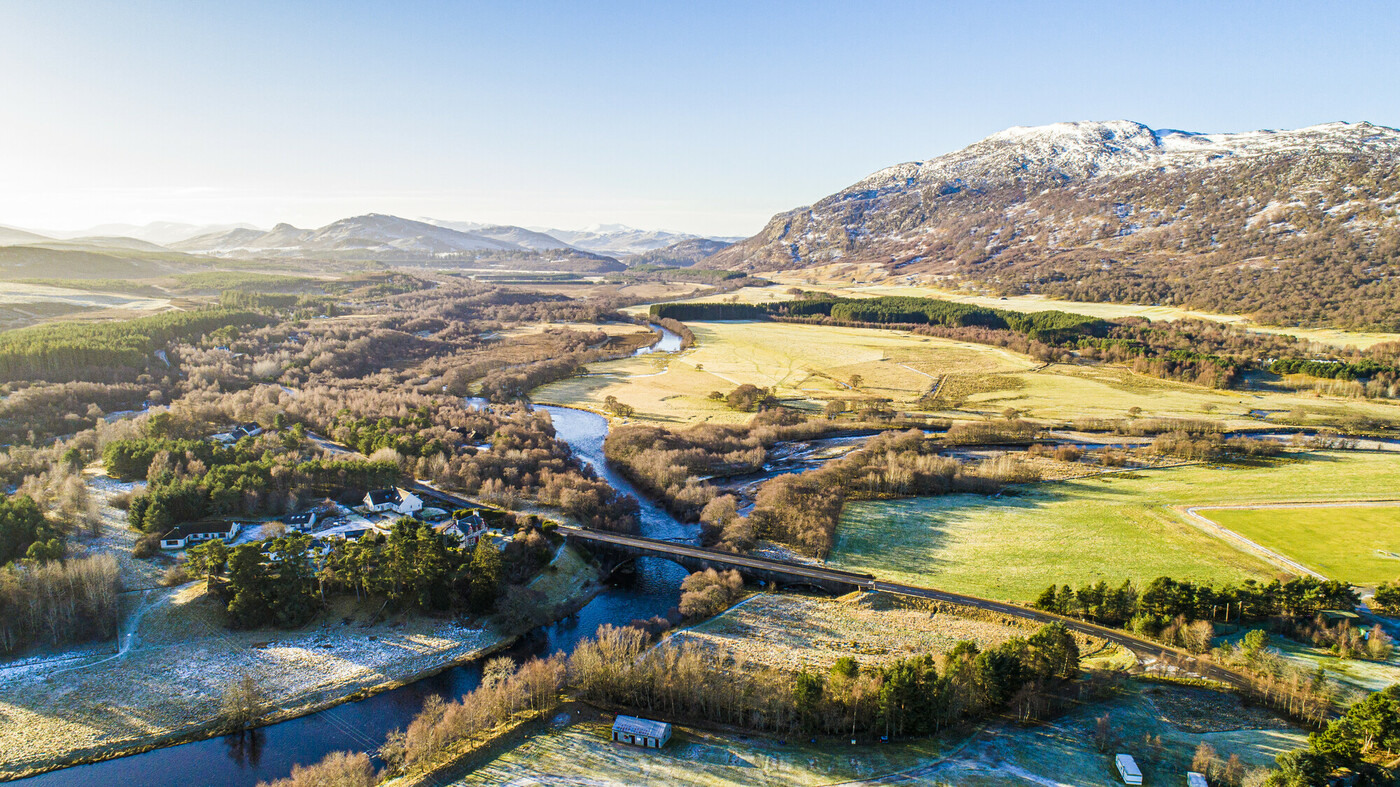
The application site is located at Dalwhinnie between a small housing development at Truim View and the River Truim itself. There are other residential properties south of Truim View and adjacent to the A889 road which lies to the west. The A9 lies to the far east on the other side of the river, with sloping land in between. A Scottish Water treatment works lies to the south and there has been some disturbance of ground to facilitate works in and around that facility in the past. Further south there is an electricity substation and beyond that the Loch Ericht hotel.
The site is presently undulating rough land with some tree cover. The river has been straightened historically in this area and is more braided in appearance downstream further north. It is located within an area identified on SEPA’s flood maps as having a high likelihood of river flooding. Electricity lines cross the site.
The adjacent River Truim is part of the River Spey Special Area of Conservation (SAC) designated for its freshwater pearl mussels, Atlantic salmon, otter and sea lamprey interests. Part of the site runs through the SAC.
There are no listed buildings within the immediate vicinity.
Proposal
- The drawings and documents associated with this application are listed below and are available on the Cairngorms National Park Authority website unless noted otherwise: https://www.eplanningcnpa.co.uk/online-applications/applicationDetails.do?activeTab=documents&keyVal=SXY54OSI0CP00
Cairngorms National Park Authority Item 5 Planning Committee 13 March 2026 Page 4 of 34
| Title | Drawing Number | Date on Plan* | Date Received |
|---|---|---|---|
| Plan — Site Location | 160343⁄9 100 Rev A | 14/04/25 | 07/11/25 |
| Plan — Section Plan | 160343⁄9 106 | 29/05/25 | 07/11/25 |
| Plan — Proposed Flood Defence Bund: Sheet 1 of 4 | 160343⁄9 101 Rev C | 15/04/25 | 07/11/25 |
| Plan — Proposed Flood Defence Bund: Sheet 2 of 4 | 160343⁄9 102 Rev A | 15/04/25 | 07/11/25 |
| Plan — Proposed Flood Defence Bund: Sheet 3 of 4 | 160343⁄9 103 Rev B | 15/04/25 | 07/11/25 |
| Plan — Proposed Flood Defence Bund: Sheet 4 of 4 | 160343⁄9 104 Rev B | 15/04/25 | 07/11/25 |
| Plan — Proposed Flood Defence Bund With Aerial Imagery — Sheet 1 of 4 | 160343⁄9 111 | 03/11/25 | 07/11/25 |
| Plan — Proposed Flood Defence Bund With Aerial Imagery — Sheet 2 of 4 | 160343⁄9 112 | 03/11/25 | 07/11/25 |
| Plan — Proposed Flood Defence Bund With Aerial Imagery — Sheet 3 of 4 | 160343⁄9 113 | 03/11/25 | 07/11/25 |
| Plan — Proposed Flood Defence Bund With Aerial Imagery — Sheet 4 of 4 | 160343⁄9 114 | 03/11/25 | 07/11/25 |
| Other — Flood Risk Assessment — River Truim at Dalwhinnie | 01/01/24 | 23/06/25 | |
| Other — Flood Mitigation and Adaptation Measures | CL Project 027 | 01/04/25 | 23/06/25 |
| Other — Technical Memo | 01/03/24 | 29/07/25 | |
| Other — Extended Phase 1 Habitat And Protected Species Survey and Assessment Report | 29/10/25 | 07/11/25 |
Cairngorms National Park Authority Item 5 Planning Committee 13 March 2026 Page 5 of 34
| Title | Drawing Number | Date on Plan* | Date Received |
|---|---|---|---|
| Other — Dalwhinnie Flood Mitigation — Supplementary Supporting Statement | 03/11/25 | 07/11/25 | |
| Other — Agent Letter to Flood Team | 29/07/25 | ||
| Other — Agent Letter to Roads Team | 29/07/25 | ||
| Other — Agent Letter to Planning Team | 29/07/25 | ||
| Other — Dalwhinnie Addendum with FRA | 01/01/26 | 19/01/26 | |
| Other — Addendum difference at WWTW | 19/01/26 |
*Where no specific day of month has been provided on the plan, the system defaults to the 1st of the month.
The proposed development seeks full planning permission to form a flood defence bund and flood relief channel between housing at Truim View and the River Truim. There is an existing bund comprising gravel embankment and wall in this area running along the west of the site. It is understood this was constructed many years ago but is no longer maintained by the Highland Council and is not providing the required level of protection for flood events. This feature, which is discrete in the landscape, will be retained as existing with the new development created further east.
The proposed bund will be approximately 1 to 1.5 metres high and 5 metres wide at its base and will run from just north of Truim View to the rear of the water treatment works. The northern section will cross over an existing track leading to drainage infrastructure with ramped access maintained over this. The bund runs south along the rear of Truim View, on the opposite side of the access road to this housing. It stops for a short section at the rear of 4 Truim View where there is existing small knoll feature, then continues southwards for a short section to run along the rear of other properties Glenisla, Glenlochsie and Truim Bank. A further bund will be formed to the east of the aforementioned knoll to then run south to the water treatment works.
Cairngorms National Park Authority Item 5 Planning Committee 13 March 2026 Page 6 of 34
In terms of construction, the applicants have advised that due to granular soils here they would need to do sheet piling which would need to be very deep. So instead, they propose to dig a trench along the line of the bund and line it with a clay liner to act as an impermeable barrier to flow below the bund and to mitigate any seepage. The height of the bund is designed to be 300mm higher than the maximum modelled water level for a 1 in 200 year event. There will be boulders on the river side toe of the bund to create a stable scour resistant face.
A drainage / flood relief trench is proposed between the bund and the river which will follow and enhance existing depressions in the landscape. This will mitigate flows by providing a controlled pathway redirecting water to the flood plain beyond, along with providing storage. It will vary in depth from 0.5 to 0.8 metres and will be around 0.6 metres wide. There will be no works within the river itself.
The applicants have explained that the bund is designed as passive earthworks with low maintenance requirements. It is intended that both the bund and channel will be micro sited to ensure minimal environmental impacts, with the channel intended to be designed to create additional habitat diversity.
The applicants have submitted a number of supporting documents as follows:
Flood Mitigation and Adaption Document – this explains why flood defences are needed, with more flooding predicted now due to climate change, including on the west side of the A889 so presenting increased flood risk. It also explains why the direct defence option was considered to be the most appropriate, and that following initial Kaya Consulting proposals, it was decided to maximise the distance between the river and the bund to reduce any potential for upstream and downstream effects.
Flood Risk Assessment (FRA) – commissioned by the Dalwhinnie Flood Resilience Group to consider the current risk of flooding and flood mitigation options. It notes that old maps showed the Truim used to be more
Cairngorms National Park Authority Item 5 Planning Committee 13 March 2026 Page 7 of 34
meandering suggesting it was straightened in the past, perhaps to protect the road or properties, with the changes in meanders suggesting it is a dynamic river. It explains the modelling illustrates that, as flows increase, water is predicted to exceed the gravel bank adjacent to Truim View and spill west flooding these properties. The modelling also predicts that this will exceed the left bank of the river by the substation, spilling onto the A889 and properties beyond. The various options considered are explained, such as storing water in upper reaches of the river and natural flood management, with opportunities considered to be limited due to the steep nature of the topography. Property level protection was considered to only protect to fairly shallow levels such as 0.5 metres, whilst flood warning systems are not a protection measure but rather a warning measure with the possibility of linking a scheme to the SSE gauging station if they were involved. The FRA also explains why dredging is not an option in environmental terms and in relation to impacts on riverbanks and downstream infrastructure.
Technical Memo by Kaya Consulting – this includes further flooding information and explains that construction of a bund would result in changes to flood depths and velocities within the modelled reach area, reducing flood depths within the built-up area of Dalwhinnie and increasing depths marginally in other areas as a result. These impacts would not extend upstream of the service station or downstream of the distillery, with no properties on the right hand side of the river (looking downstream) to impact upon.
Additional information on flood risk – this has been provided to address points raised by the technical consultees and includes explanatory letters and an addendum to the FRA providing the additional information sought in relation to different ranges of flood events.
Supplementary Supporting Statement – this explains the history of the development of the Dalwhinnie Flood Resilience Group and how the group has worked with local stakeholders and the community to develop these proposals. It also outlines their aspiration that the defences be formally adopted.
Cairngorms National Park Authority Item 5 Planning Committee 13 March 2026 Page 8 of 34
Extended Phase 1 Habitat and Protected Species Survey and Assessment Report – this sets out that the site is primarily poor semi-improved grassland with tall ruderal vegetation of low ecological value and scattered trees. To compensate for loss of grassland, it is recommended that native species rich wildflower mixes are sown at suitable locations and that trees are retained where possible with further riverside planting of water tolerant native trees to slow water flow in the flood plain.
The survey considered that there is negligible bat roost potential in trees; low impact to amphibians, reptiles and small mammals; and low to negligible potential for impacts on badger, beaver, red squirrel, pine marten, wildcat, otter or water vole. A single otter spraint was recorded in the area. Detailed recommendations for mitigation and enhancement are outlined, including: provision of Construction Environment Management Plan; planting of trees and shrubs; enhancing grassland; pre-construction otter survey and recommendations for reducing potential disturbance; briefing of workers and measures to avoid mammal entrapment; care to check for amphibians, reptiles, small mammals and nesting birds; and installation of bat and bird boxes.
History
There are no planning applications on the site itself, but there have been some applications in the vicinity as follows:
05/00163/REMBS (approval of reserved matters) — Erection of four dwellings at Land Adjacent to Village Hall approved by the Highland Council. (This the Truim View development).
Developments at the waste-water treatment works to the south are as follows, all approved by the Highland Council: a) 07/00333/FULBS — Installation of pump sump, sand filter and limestone contactor. b) 18/05596/FUL — Erection of new water treatment works comprising two treatment buildings, hard standings & site landscaping.
Cairngorms National Park Authority Item 5 Planning Committee 13 March 2026 Page 9 of 34
c) 21/04075/FUL Construction of new Water Treatment Works (Amendment to 18/05596/FUL) — this involved a slightly bigger site to accommodate some additional infrastructure.
- Developments on the opposite (south-east) side of the river are as follows, all approved by the Highland Council: a) 2018/05623/FUL — Installation of private access track to service public water supply boreholes with local landscaping and chamber covers at Land 275M East Of Waste Water Treatment Works Dalwhinnie. b) 2018/01364/FUL- Formation of access track, sinking of 4No. boreholes, ground re-profiling, fencing at land 275M East Of Waste Water Treatment Works Dalwhinnie.
Habitats Regulations Appraisal
A Habitats Regulations Appraisal (HRA) has been undertaken to consider the potential effects of the development upon the conservation objectives of European sites. The HRA document is attached as Appendix 2. The European site in this case is the River Spey Special Area of Conservation (SAC) designated for its Atlantic salmon, freshwater pearl mussels (FWPM), sea lamprey and otter interests.
The HRA notes whilst there are no in-channel works, the proposal involves construction of flood defence bunds next to the River Truim, together with a drainage ditch which may be a route for construction phase mobilised sediment or pollution to enter the watercourse. It is considered that there are likely significant effects upon the interests of the River Spey SAC in terms of short-term effects on otter from construction activity including potential for disturbance of any holts or resting sites, and indirect impacts through potential change in water quality and impacts on prey species. There is also potential for operational phase loss of habitat as the proposed drainage ditch crosses into terrestrial habitat within the SAC.
With regard to freshwater pearl mussel, NatureScot has advised that whilst a FWPM survey was not carried out it is very unlikely that there would be any this far up the catchment so no likely significant effects are predicted. This is
Cairngorms National Park Authority Item 5 Planning Committee 13 March 2026 Page 10 of 34
also considered to be the case for sea lamprey. In terms of Atlantic salmon, it is considered that there may be short term effects during construction through release of sediment mobilised from riverbanks that could smother Atlantic salmon spawning gravels downstream from the site as well as potential impacts from any fuel spills. NatureScot has also advised that there may be potential impacts on salmon habitats as a result of the bunds limiting the flood plain and constraining the watercourse which may result in uncertain changes in the force of the water within the watercourse.
The HRA has concluded that these likely significant effects can be satisfactorily addressed by suitable mitigation. This mitigation includes preconstruction protected species surveys together with production and implementation of an otter species protection plan identifying appropriate mitigation measures if there is evidence of protected species; timing of works to avoid Atlantic salmon spawning season; and submission of pollution prevention plan. Potential impacts arising from any localised changes to force of flow in the river are not considered to impact on the integrity of the designated site because of the restricted length of river affected, the limited impacts on water storage capacity in the floodplain due to the proposed works being set back from the river, and the fact that the river is already mobile especially downstream whereby there should not be a change in geomorphology.
On this basis, it is concluded that the conservation objectives of the designated sites will be met and there will not be an adverse effect on site integrity of the designated sites. NatureScot have confirmed agreement with these conclusions.
Development plan context
Policies
| National policy | National Planning Framework 4 (NPF4) Scotland 2045 (Policies relevant to the assessment of this application are marked with a cross (x)) |
|---|---|
| Policy 1 Tackling the climate and nature crises | X |
| Policy 2 Climate mitigation and adaptation | X |
Cairngorms National Park Authority Item 5 Planning Committee 13 March 2026 Page 11 of 34
| Policy 3 Biodiversity | X |
|---|---|
| Policy 4 Natural places | X |
| Policy 5 Soils | X |
| Policy 6 Forestry, woodland and trees | X |
| Policy 7 Historic assets and places | X |
| Policy 8 Green belts | |
| Policy 9 Brownfield, vacant and derelict land, and empty buildings | X |
| Policy 11 Energy | |
| Policy 12 Zero waste | |
| Policy 13 Sustainable transport | X |
| Policy 14 Design, quality and place | X |
| Policy 15 Local living and 20 minute neighbourhoods | |
| Policy 16 Quality homes | |
| Policy 17 Rural homes | |
| Policy 18 Infrastructure first | X |
| Policy 19 Heating and cooling | |
| Policy 20 Blue and green infrastructure | X |
| Policy 21 Play, recreation and sport | |
| Policy 22 Flood risk and water management | X |
| Policy 23 Health and safety | X |
| Policy 24 Digital infrastructure | |
| Policy 25 Community wealth building | X |
| Policy 26 Business and industry | |
| Policy 27 City, town, local and commercial centres | |
| Policy 28 Retail | |
| Policy 29 Rural development | |
| Policy 30 Tourism | |
| Policy 31 Culture and creativity | |
| Policy 32 Aquaculture | |
| Policy 33 Minerals |
Cairngorms National Park Authority Item 5 Planning Committee 13 March 2026 Page 12 of 34
| Strategic policy | Cairngorms National Park Partnership Plan 2022 – 2027 | |
|---|---|---|
| Local plan policy | Cairngorms National Park Local Development Plan (2021) (Policies relevant to the assessment of this application are marked with a cross (x)) | |
| Policy 1 | New housing development | |
| Policy 2 | Supporting economic growth | |
| Policy 3 | Design and placemaking | X |
| Policy 4 | Natural heritage | X |
| Policy 5 | Landscape | X |
| Policy 6 | The siting and design of digital communications equipment | |
| Policy 7 | Renewable energy | |
| Policy 8 | Open space, sport and recreation | |
| Policy 9 | Cultural heritage | X |
| Policy 10 | Resources | X |
| Policy 11 | Developer obligations |
- All new development proposals require to be assessed in relation to policies contained in the adopted Development Plan which comprises National Planning Framework 4 (NPF4) and the Cairngorms National Park Local Development Plan 2021 (LDP). The full wording of policies can be found at: https://www.gov.scot/publications/national-planning-framework‑4/documents/ and at: https://cairngorms.co.uk/wp-content/uploads/2021/03/CNPA-LDP-2021-web.pdf
Planning guidance
- Supplementary guidance also supports the Local Development Plan and provides more details about how to comply with the policies. Guidance that is relevant to this application is marked with a cross (x).
| Policy 1 | Housing supplementary guidance | |
|---|---|---|
| Policy 2 | Supporting economic growth non-statutory guidance | X |
| Policy 3 | Design and placemaking non-statutory guidance | X |
Cairngorms National Park Authority Item 5 Planning Committee 13 March 2026 Page 13 of 34
| Policy 4 | Natural heritage non-statutory guidance | X |
|---|---|---|
| Policy 5 | Landscape non-statutory guidance | X |
| Policy 7 | Renewable energy non-statutory guidance | |
| Policy 8 | Open space, sport and recreation non-statutory guidance | |
| Policy 9 | Cultural heritage non-statutory guidance | X |
| Policy 10 | Resources non-statutory guidance | X |
| Policy 11 | Developer obligations supplementary guidance |
Consultations
A summary of the main issues raised by consultees now follows:
SEPA was consulted as the site lies within an area of flood risk. They noted that they are generally supportive of actions to manage flood risk providing this does not result in increased risk for others as required by NPF4 Policy 22. They initially lodged a holding objection due to lack of information to demonstrate that there would be no increased flood risk elsewhere or a need for future flood protection schemes.
Further information initially provided by the applicant did not address all of SEPA’s concerns, however on receipt of an addendum to the FRA in January 2026 (which included modelling at impacts at the wastewater treatment works) SEPA have withdrawn their objections. They advise that this has satisfactorily demonstrated that the proposed flood defence bund would not have a significant detrimental impact on flood risk to surrounding receptors and that the risk to properties when overtopped would not result in increased flood levels. Outwith the area of benefit there are some areas at increased risk of flooding, but this is mostly limited to the watercourse itself and areas immediately adjacent where there are no receptors.
SEPA have highlighted that given the informal nature of this flood defence bund, their flood maps will not be updated to take account of it. Additionally, the defences will not be taken into account when determining planning applications, and any Flood Risk Assessments for future development will need to take account of flood risk in the absence of the protection offered by
Cairngorms National Park Authority Item 5 Planning Committee 13 March 2026 Page 14 of 34
the bund. They have also noted that whilst the flood level in the area of benefit is generally reduced, when the capacity of the bund is exceeded it may be that water is held in the area for longer. They therefore recommend that this is considered within the design and construction of the bund. Also, any breach of defence should be considered within any maintenance arrangements. These matters can be included as an informative to any consent