
Item 6 Wildlife Ponds Committee Report 20250335DET
Committee report
Development proposed: Formation of 10 wildlife ponds at Site at Knock House, Strathgirnoc, Birkhall, Ballater
Reference: 2025/0335/DET Applicant: Timothy Coleshow, British Dragonfly Society Date called-in: 23 December 2025 Recommendation: Approve Case officer: Katherine Donnachie, Planning Officer
Item 6 Planning Committee 13 March 2026 Page 2 of 21
Map showing site locations.
(Data source: CNPA Crown copyright and database rights 2026. Ordnance Survey AC0000821810 OS licensed colour raster MM (NG): Built environment CNP: CNPA ©Crown copyright and database rights 2023 OS 160040965 OS licensed colour MM (NG): The representation of features or boundaries in which CNPA or others have an interest does not necessarily imply their true positions. For further information please contact the appropriate authority. Brochdhu Fire Tower R Mill of Sterin Alltcailleach Forest) This map has been produced to aid in the statutory process of dealing with planning applications. The map is to help identify the site and its surroundings and to aid Planning Officers, Committee Members and the Public in the determination of the proposal. Maps shown in the Planning Committee Report can only be used for the purposes of the Planning Committee. Any other use risks infringing Crown Copyright and may lead to prosecution or civil proceedings. Maps produced within this Planning Committee Report can only be reproduced with the express permission of the Cairngorms National Park Authority and other Copyright holders. This permission must be granted in advance.
Item 6 Planning Committee 13 March 2026 Page 3 of 21
Site description, proposal and history
Site description
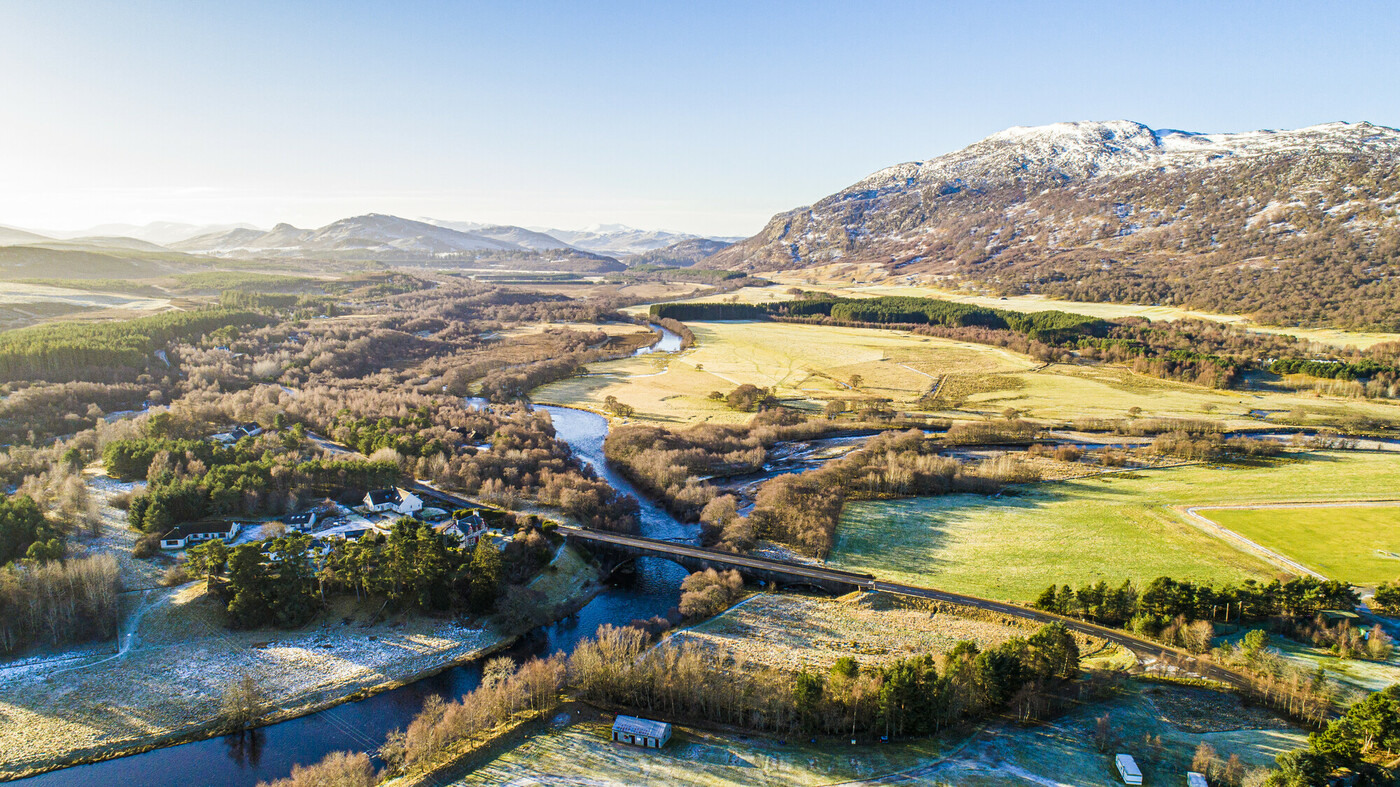
- The application covers a number of sites to the west of Ballater at six separate locations to the north and south of the B976 back road from Ballater to Crathie which runs to the south of the River Dee. All the sites are located on the Abergeldie Estate on rough or wet grassland.
- The proposed wildlife ponds are not located on any designated sites. Two of the pond sites are closer to the River Dee Special Area of Conservation (SAC) but are outwith this site. The Cairngorms Massif Special Protection Area (SPA) lies further west. There is a category B listed building of architectural and historic importance at Mill of Cosh in the vicinity of where three of the pond sites are located.
- All of the proposed pond sites are accessed by existing tracks from the public road which serve other properties.
Proposal
- The drawings and documents associated with this application are listed below and are available on the Cairngorms National Park Authority website unless noted otherwise: https://www.eplanningcnpa.co.uk/online-applications/applicationDetails.do?activeTab=documents&keyVal=T7DA4SSI0CP00
| Title | Drawing Number | Date on Plan* | Date Received |
|---|---|---|---|
| Plan — Location Plan — Location of Proposed Ponds | 16/12/25 | ||
| Plan — Site Plan — Ponds 1 & 2 | 16/12/25 | ||
| Plan — Site Plan — Pond 3 | 16/12/25 | ||
| Plan — Site Plan — Pond 4 | 16/12/25 | ||
| Plan — Site Plan — Pond 5 | 16/12/25 | ||
| Plan — Site Plan — Pond 6 | 16/12/25 | ||
| Plan — Site Plan — Pond 7 | 16/12/25 | ||
| Plan — Site Plan — Pond 8 | 16/12/25 |
Item 6 Planning Committee 13 March 2026 Page 4 of 21
| Title | Drawing Number | Date on Plan* | Date Received |
|---|---|---|---|
| Plan — Site Plan — Pond 9 | 16/12/25 | ||
| Plan — Site Plan — Pond 10 | 16/12/25 | ||
| Plan — Pond Dimensions Sketch | 16/12/25 | ||
| Plan — Pond Profiles | 16/12/25 | ||
| Plan — Deeside Northern Damselfly Connections | 16/12/25 | ||
| Plan — A1 New Pond Site Drawing | 16/12/25 | ||
| Plan — A2 New Pond Site Drawing | 16/12/25 | ||
| Plan — A3 New Pond Site Drawing | 16/12/25 | ||
| Plan — A4 New Pond Site Drawing | 16/12/25 | ||
| Plan — A5 New Pond Site Drawing | 16/12/25 | ||
| Plan — A6 New Pond Site Drawing | 16/12/25 | ||
| Plan — A7 New Pond Site Drawing | 16/12/25 | ||
| Plan — A8 New Pond Site Drawing | 16/12/25 | ||
| Plan — A8 (and A9) New Pond Site Drawing | 16/12/25 | ||
| Plan — A10 New Pond Site Drawing | 16/12/25 | ||
| Other — Aerial View — Photo — A1, A2, and A3 | 29/12/25 | ||
| Other — Aerial View — Photo — A4 | 29/12/25 | ||
| Other — Aerial View — Photo — A5 | 29/12/25 | ||
| Other — Aerial View — Photo — A6 and A7 | 29/12/25 | ||
| Other — Aerial View — Photo — A8 and A9 | 29/12/25 | ||
| Other — Aerial View — Photo — A10 | 29/12/25 |
Item 6 Planning Committee 13 March 2026 Page 5 of 21
| Title | Drawing Number | Date on Plan* | Date Received |
|---|---|---|---|
| Other — Northern damselfly Pond Project Description | 16/12/25 | ||
| Other — Ecological and Historic Environment Report for Abergeldie Ponds 2025 | 16/12/25 |
*Where no specific day of month has been provided on the plan, the system defaults to the 1st of the month.
- This application seeks full planning permission to form 10 separate ponds as part of a project to provide a network of more than 100 ponds for the rare northern damselfly across the National Park from Braemar to Aboyne along the River Dee corridor. This will connect existing known sites for damselfly and create new habitat for them, providing resilience for them in the face of climate change. The applicants advise that Northern damselfly is at threat due to its restricted distribution and because of climate change drying out ponds. They note that a trial project in Strathspey saw colonisation of new ponds. Consequently, they see the creation of a network of new ponds as a quick, easy and inexpensive way to provide new habitat for a range of species whilst also providing a simple wetland network in the landscape.
- The ponds are small in scale, each around 150 square metres with approximate dimensions of 15 metres by 10 metres. They will be irregularly shaped to suit the local landscape. The centre of the pond will be around 1.2 to 1.5 metres deep, with the pond edges around 0.3 to 0.5 metres deep as northern damselfly prefer sedge filled edges of ponds in water of this depth. They will be formed essentially by digging a hole in the ground and will then fill naturally with water, with no connections to watercourses and no infrastructure such as dams, liners, or embankments required. No material will be imported into the site, and they will be located on areas with damp vegetation, in depressions or below the break of a slope to help ensure they fill with water naturally.
- The ponds will be constructed using an 8T excavator or similar on wide tracks and low ground pressure to reduce damage to vegetation, with all sites accessed via existing tracks and roads throughout the estate. It is proposed to build the ponds in the autumn through to early spring to allow them to fill with water naturally and
Item 6 Planning Committee 13 March 2026 Page 6 of 21
to avoid the bird breeding season. The landowner, Abergeldie Estate, is supportive of the project and has been involved in the selection of sites.
- A total of ten ponds is proposed as follows. Plans of the proposals are attached as Appendix 1: a) Three ponds in the vicinity of Knock House to the south of the B976 public road, accessed through the roadside fields. These ponds are located in a low lying area of marshy rush land at the bottom of these fields. b) One pond at Balhalloch Cottage, accessed via an existing track leading past this estate cottage. This site lies to the north of the public road and to the immediate south of the River Dee. It is situated in a natural gap in the woodland. The proposed pond will be located sufficiently distant from the trees to avoid any damage during construction, with no trees to be removed. c) Three ponds at Mill of Cosh to the south of the public road, accessed via an existing track. These three ponds will be located on rough marshy ground to the southwest of the existing category B listed mill complex. d) Two ponds at Dalraddie House located to the north of the public road and taking access via a long track to Dalraddie House itself. The ponds are located on rough ground to the north of the property, with this land surrounded by woodland. The River Dee lies to the north beyond the woodland. e) One pond at Khantore to the south of the public road along a track which serves a number of other estate properties including Khantore Cottage. The site is located at the foot of an embankment on a depression in rough ground and will be accessed from the track to the west via the flatter part of the field here.
- A number of supporting documents have been submitted as follows:
- Project Description – outlines the history, design and rationale for the project. It also highlights that the survey work found that there were no priority habitats, protected species or ground water dependent terrestrial ecosystems on any of the sites. It notes that a search of Historic Environment Records highlighted that the ponds are all over 30 metres from any archaeological features. Historic Environment maps are included with the submission.
Item 6 Planning Committee 13 March 2026 Page 7 of 21
- Ecological and Historic Environment Report – includes a protected species survey of the site and NVC survey. The only protected species noted was a viviparous lizard. Peat probing was carried out to ensure sites avoided any areas of deep peat.
History
- There is no planning history on the sites.
Habitats regulations appraisal
- It is not considered that the proposed development is likely to have a significant impact upon a designated European Site, as outlined below in the comments of the Park Authority’s Ecology Officer. Consequently, a Habitats Regulations Appraisal (HRA) is not required in this case.
Development plan context
Policies
National Planning Framework 4 (NPF4) Scotland 2045 (Policies relevant to the assessment of this application are marked with a cross (x))
| National policy | Policy | |
|---|---|---|
| Policy 1 | Tackling the climate and nature crises | x |
| Policy 2 | Climate mitigation and adaptation | x |
| Policy 3 | Biodiversity | x |
| Policy 4 | Natural places | x |
| Policy 5 | Soils | x |
| Policy 6 | Forestry, woodland and trees | x |
| Policy 7 | Historic assets and places | x |
| Policy 8 | Green belts | |
| Policy 9 | Brownfield, vacant and derelict land, and empty buildings | |
| Policy 11 | Energy | |
| Policy 12 | Zero waste | |
| Policy 13 | Sustainable transport | |
| Policy 14 | Design, quality and place | x |
| Policy 15 | Local living and 20 minute neighbourhoods |
Item 6 Planning Committee 13 March 2026 Page 8 of 21
| Policy | Quality homes | |
|---|---|---|
| Policy 16 | Quality homes | |
| Policy 17 | Rural homes | |
| Policy 18 | Infrastructure first | |
| Policy 19 | Heating and cooling | |
| Policy 20 | Blue and green infrastructure | x |
| Policy 21 | Play, recreation and sport | |
| Policy 22 | Flood risk and water management | |
| Policy 23 | Health and safety | |
| Policy 24 | Digital infrastructure | |
| Policy 25 | Community wealth building | |
| Policy 26 | Business and industry | |
| Policy 27 | City, town, local and commercial centres | |
| Policy 28 | Retail | |
| Policy 29 | Rural development | |
| Policy 30 | Tourism | |
| Policy 31 | Culture and creativity | |
| Policy 32 | Aquaculture | |
| Policy 33 | Minerals |
Strategic policy Cairngorms National Park Partnership Plan 2022 – 2027
Cairngorms National Park Local Development Plan (2021) (Policies relevant to the assessment of this application are marked with a cross (x))
| Local plan policy | Policy | |
|---|---|---|
| Policy 1 | New housing development | |
| Policy 2 | Supporting economic growth | |
| Policy 3 | Design and placemaking | x |
| Policy 4 | Natural heritage | x |
| Policy 5 | Landscape | x |
| Policy 6 | The siting and design of digital communications equipment | |
| Policy 7 | Renewable energy | |
| Policy 8 | Open space, sport and recreation | |
| Policy 9 | Cultural heritage | x |
| Policy 10 | Resources | x |
Item 6 Planning Committee 13 March 2026 Page 9 of 21
| Policy | Developer obligations |
|---|---|
| Policy 11 | Developer obligations |
- All new development proposals require to be assessed in relation to policies contained in the adopted Development Plan which comprises National Planning Framework 4 (NPF4) and the Cairngorms National Park Local Development Plan 2021. The full wording of policies can be found at: https://www.gov.scot/publications/national-planning-framework‑4/documents/ and at: https://cairngorms.co.uk/wp-content/uploads/2021/03/CNPA-LDP-2021-web.pdf
Planning guidance
- Supplementary guidance also supports the Local Development Plan and provides more details about how to comply with the policies. Guidance that is relevant to this application is marked with a cross (x).
| Policy | Guidance | |
|---|---|---|
| Policy 1 | Housing supplementary guidance | |
| Policy 2 | Supporting economic growth non-statutory guidance | |
| Policy 3 | Design and placemaking non-statutory guidance | x |
| Policy 4 | Natural heritage non-statutory guidance | x |
| Policy 5 | Landscape non-statutory guidance | x |
| Policy 7 | Renewable energy non-statutory guidance | |
| Policy 8 | Open space, sport and recreation non-statutory guidance | |
| Policy 9 | Cultural heritage non-statutory guidance | x |
| Policy 10 | Resources non-statutory guidance | x |
| Policy 11 | Developer obligations supplementary guidance |
Consultations
- A summary of the main issues raised by consultees now follows:
- Aberdeenshire Council Archaeology team has no comments.
Item 6 Planning Committee 13 March 2026 Page 10 of 21
- Aberdeenshire Council Flood Risk Management team advise that considering the nature of the application and the location of the proposed ponds they are generally satisfied with the proposals.
- Aberdeenshire Council Contaminated Land Team has been consulted and no comments have been received at the time of writing.
- Aberdeenshire Council Natural Environment Team note that they welcome this valuable project to assist a regionally important species. They accept the conclusions of the ecology surveys and note that work will be timed to avoid the bird breeding season. They also note that work should be conditioned to accord with the ecology surveys. Finally, they advise that although some of the ponds are located close to designated sites, none are within the designated sites whereby there is no requirements to consult NatureScot.
- Cairngorms National Park Authority Ecology Officer has considered the application in relation to the impacts on designated sites. It is considered that a Habitat Regulations Appraisal is not required given that no construction activity will take place within designated sites, the proposed ponds are isolated from the watercourses which connect to the River Dee SAC, and the project involves only small-scale construction work aimed at delivering ecological enhancement.
- The officer further notes that no trees will be felled, and that small birch and willow saplings (under 1 metre high) are to be translocated within the site of ponds 6 and 7 so that they will not be damaged. Accordingly, impacts on trees and woodland habitats will be negligible.
- The submitted habitats and protected species surveys found limited evidence of protected species. However, there is potential for protected species such as reptiles to be present when construction starts, so it is recommended that pre-construction site checks be carried out to reduce the risk of any harm. A breeding bird survey has not been carried out and habitats at all of the pond sites are considered to be suitable for a range of species. Impacts can be mitigated by timing of works to avoid the bird breeding season as proposed by the applicants.
Item 6 Planning Committee 13 March 2026 Page 11 of 21
- With regard to priority habitats and species, the officer notes that the proposed development will directly support the establishment of populations of northern damselfly, which is a priority species. This will create significant positive effects for the damselfly, wider biodiversity and the delivery of a landscape scale nature network. In terms of impacts on peatland habitats and carbon rich soils it is noted that peat survey techniques have been used to micro site the ponds away from deep peat and the design of the ponds avoids linear connected features that could drain surrounding shallow peat deposits so reducing any impacts on these habitats.
- With regard to the water environment, there will be no construction activity within the watercourse or within existing permanent wetland habitats. Potential construction stage impacts will therefore be limited. However invasive non-native species (INNS) were not mentioned in the survey work and the spread of such species between sites could have potential for impacts.
- These matters can all be addressed by appropriate planning conditions in the event of the application being supported. Finally, with regard to biodiversity enhancements, it is noted that this is the main objective of the proposed development with the promotion of ecological interest being integral to it.
- Cairngorms National Park Authority Landscape Adviser advises that the proposed development would change the landscape character in a way that would fit with the special landscape qualities and the key landscape characteristics of the sites and wider area.
- It is noted that the construction period would introduce people, materials and machinery into the site where these are largely absent, causing disruption to the landscape character and visual amenity of people using the nearby tracks and residential properties. However, is further noted that new access tracks would not be required, construction methods would limit landscape and visual effects and that the construction period would be relatively short.
- The advisor has also noted that the shape of the ponds would be naturalistic and the riparian vegetation that establishes would be native and suited to wet ground.
Item 6 Planning Committee 13 March 2026 Page 12 of 21
It is considered that the ten ponds would enhance and diversify the rural character of the Upper Deeside: Inver to Cambus O’ May landscape character area; and the Cairngorm National Park special landscape qualities of Glens and Straths, Trees, Woods and Forests.
- It is concluded that the proposal would retain the distinctive character of the rural area and has been designed to avoid adverse effects and optimise opportunities to enhance and improve the visual amenity and landscape character of the site. There are likely to be minimal temporary adverse effects during the construction period but best practice techniques would be employed to reduce, minimise and mitigate these temporary impacts as appropriate.
- Finally, the advisor has highlighted that further information will be required regarding tree protection during construction and regarding road access or any areas of public access which require to be closed during construction.
- Balmoral Estates advise that they support the application in terms of nature restoration, ecological benefits, and flood mitigation through retention of surface water.
- Ballater and Crathie Community Council have advised that they support this application. They have asked that the Dee Resilience Strategy Group are involved to give thought as to whether any possible modifications to the scheme could result in additional benefits such as improvements to the water table and reduction in flooding risk in addition to the clear ecological value of the project. A copy of the Community Council’s comments is attached as Appendix 2.
Representations
- The application was advertised and no representations have been received.
Appraisal
- Section 25 of the 1997 Act as amended requires applications to be determined in accordance with the Development Plan. This comprises National Planning Framework 4 (NPF4) and the Cairngorms National Park Local Development Plan
Item 6 Planning Committee 13 March 2026 Page 13 of 21
2021 (LDP). Where there is conflict between policies, NPF4 policies take precedence.
- The main planning considerations in this case are: the principle in terms of sustainability and climate change; landscape and design; environmental impacts; flooding; amenity; transport and outdoor access; and cultural heritage. These are considered in below.
Principle – Sustainability and climate change
- NPF4 Policy 1: Tackling the climate and nature crises seeks to ensure that significant weight is given to the global climate and nature crises when considering all development proposals, while NPF4 Policy 2: Climate mitigation and adaptation seeks to encourage development that adapts to the current and future impacts of climate change. Similarly, LDP Policy 3: Design and Placemaking requires new development to minimise the effects on climate change.
- In this case the proposed development seeks to create a series of wildlife ponds to help create suitable breeding habitat for a priority species (northern damselfly) which will connect to existing known sites for this species so helping to safeguard this valuable species in the face of climate change. As noted by the environmental consultees, it will also help support creation of a functional freshwater / wetland nature network along Deeside. The works are minimal in terms of scale and size, will not involve the loss of agricultural land, and have no requirement to import materials to create the ponds.
- In these circumstances the principle of the proposed development is considered to readily support the objectives of NPF4 and LDP planning policies subject to the details of siting and environmental impacts being satisfactory which will now be considered.
Landscape and design
- NPF4 Policy 4: Natural places sets out that development proposals which affect a National Park will only be supported where the objectives of designation and the overall integrity of the area will not be compromised. LDP Policy 5: Landscape sets out similar objectives with a presumption against any development that does not
Item 6 Planning Committee 13 March 2026 Page 14 of 21
conserve or enhance the landscape character or special landscape qualities of the National Park.
- NPF4 Policy 14: Design, quality and place seeks to ensure that development proposals improve the quality of the area and are consistent with the six qualities of successful places: healthy, pleasant, connected, distinctive, sustainable, and adaptable. Similarly, LDP Policy 3: Design and placemaking also seeks to ensure that proposals improve the quality of the area and are consistent with the six qualities of successful places.
- The scale of the proposed developments is very small and will have minimal landscape impacts. The choice of locations enables the ponds to sit in the local landscape with little if any impact, being located either on marshy land or on natural clearings within woodland. Furthermore, the locations are visually discrete within the Abergeldie Estate. The works to create the ponds are also minimal, with the details of the proposed construction supporting natural revegetation of any disturbed areas with no importation of materials required.
- In these circumstances it is considered that the proposal will readily conserve and enhance the landscape character and special landscape qualities of the National Park and is consistent with all the qualities of a successful place. As such it is considered to comply with relevant NPF4 and LDP policies.
Environmental impacts
- NPF4 Policy 3: Biodiversity requires that development proposals contribute to the enhancement of biodiversity including, where relevant, restoring degraded habitats and building and strengthening nature networks and the connections between them. NPF4 Policy 4: Natural places does not support development which will have an unacceptable impact on the natural environment, or which will have a significant effect on European Site designations which include Special Areas of Conservation and Sites of Special Scientific Interest. NPF4 Policy 20: Blue and green infrastructure sets out that development which incorporates or enhance blue and / or green infrastructure with proposals for their future management to be included. Similarly, LDP Policy 4: Natural heritage requires new development to have no adverse effects on the integrity of designated sites, the National Park, or on protected species or habitats
Item 6 Planning Committee 13 March 2026 Page 15 of 21
including those identified in the Cairngorms Nature Action Plan and UK Biodiversity Action Plan. Policy 3: Design and Placemaking also requires development to create opportunities for further biodiversity and to promote ecological interest.
- As outlined previously, this application’s core purpose is to support biodiversity and to help create a nature network. As noted by the Park Authority’s Ecology Adviser, it has biodiversity enhancement as its main objective, and the promotion of ecological interest is integral to the design of the application. The proposed formation of a series of small wildlife ponds for Northern Damselfly (a Cairngorms and Scottish Biodiversity List Priority Species) at multiple sites along Deeside will provide suitable breeding habitat and will also benefit many other aquatic and terrestrial species and increase the extent and connectivity of freshwater habitats in this area.
- In terms of the impacts of this small-scale development on the local environment, the Park Authority’s Ecology Adviser is satisfied with the proposal subject to appropriate planning conditions being attached to any planning permission relating to Construction Environment Management Plans, preconstruction surveys and timing of works to avoid the bird breeding season. There is also not considered to be an impact on the designated site in the vicinity (River Dee SAC).
- Finally, no trees are to be felled, with existing trees to be protected and the small trees under 1 metre high in the vicinity of the two ponds at Mill of Cosh to be translocated. Consequently, the proposals do not conflict with NPF4 Policy 6: Forestry, woodland and trees which supports development