LOAF Casework Paper 2026 (ink saver)
Cairngorms Local Outdoor Access Forum Sarah Lawther and Vicky Hilton, Outdoor Access Officers
2025/2026 Delivery of section 10 and 13 statutory duties as conferred by the Land Reform (Scotland) Act 2003
Purpose
This paper is presented in order to update LOAF members on delivery of the Park Authorities statutory duties under the Land Reform (Scotland) Act 2003.
Background
Part one of the Land Reform (Scotland) Act 2003 (“the LRA” or “the Act”) sets out the statutory duties, responsibilities and powers of national park authorities in relation to the provision and promotion of the right of access. Under part one of the LRA the Park Authority has four specific duties including:
- Section 10: The Scottish Outdoor Access Code (“SOAC” or the Code”)- There is a duty on the Park Authority, by section 10(7) (a) of the Act, to publicise the Code.
- Section 13: Duty to uphold access rights- Section 13(1) of the Act places a duty on the Park Authority to uphold access rights which entails asserting, protecting, keeping open and free from obstruction any route, waterway or other means by which access may reasonably be exercised.
Duty to promote responsible behaviour / SOAC
Public engagement
Direct public engagement activities promoting responsible behaviour and the Scottish Outdoor Access Code (SOAC) are undertaken by Park Authority access officers and ranger staff. Details of this engagement are given below for the period February 2025 to January 2026.
| Activity | No. of people | No. of sessions | Activities |
|---|---|---|---|
| School groups | 235 | 10 | • Delivery of SOAC education programme in four high schools and three primary schools |
| Public events | 28 | 1 | • Ranger “pop-up” event (stall in car park on busy day) |
| CPD / Training | 42 | 3 | • SOAC training sessions to Park Authority staff and volunteer rangers. |
| Junior rangers | 22 | 5 | • General SOAC during sessions |
| Total number of people directly engaged with | 327 |
NB This describes formal dedicated access activity only, so does not include ranger patrolling and informal conversations at other community events.
Publications
The Park Authority continues to promote the Code under the auspices of Tread Lightly in the Park, the list of publications / signs include:
- Main general Tread Lightly leaflet
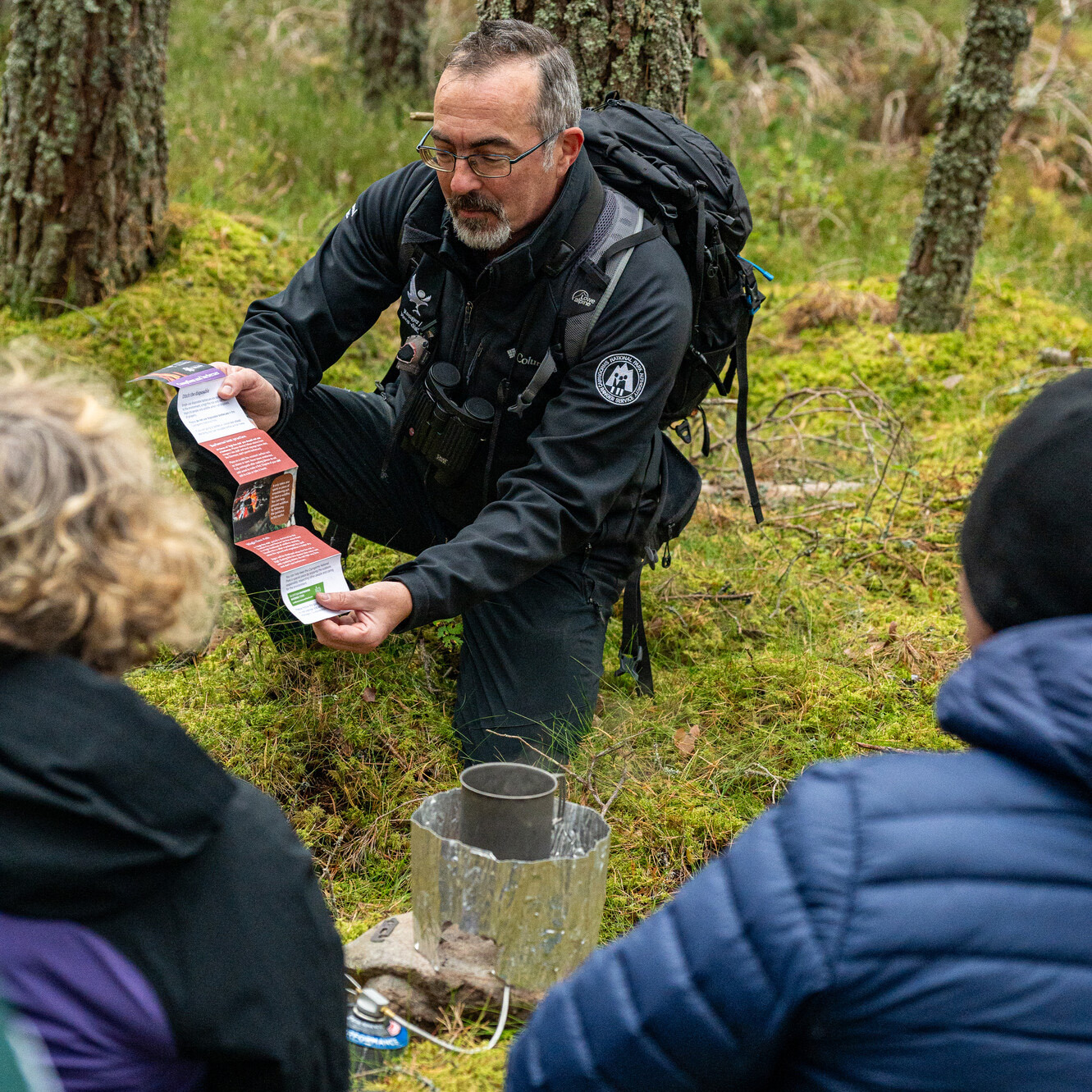
- Fire and barbeque leaflet
- “High Fire Risk” magnetic vehicle signs for all rangers’ vans and partner ranger service vehicles
- Responsible behaviour poster signs – suite of 5 poster signs
- Wildlife disturbance signage – for capercaillie and waders – site specific map panels and dogs on leads signs, signs for Slavonian grebe breeding site
- Farming signs – Dogs & livestock, Dogs & lambs (2 versions)
Digital promotion — Social media
Responsible behaviour messages were promoted on social media (Facebook and Instagram) between March and October on subjects such as responsible dog ownership, wildlife disturbance, wildfire awareness and mushroom foraging. A total of 32 posts ran (58), which achieved 319,120 impressions (156,137), 550 comments (85) and 4,483 reactions (3,661). [2024 figure in brackets].
Post numbers are less than last year as more work was done in partnership with VisitCairngorms who delivered a lot of the visitor management campaign posts. As the tourism body, the social media followers of VisitCairngorms consist of a high proportion of visitors to the Park, who are a key target audience for much of the responsible behaviour messaging.
Duty to uphold access rights
Analysis of annual records
The current record shows a slight decrease in S14 casework (obstructions to access rights e.g. locked gates) for the review period 1 April 2025 to beginning of February 2026. Records for the review period compare as follows:
- 2025⁄26 – 13 cases (5 live)
- 2024⁄25 — 24 cases (2 live)
- 2023⁄24 — 33 (0 live)
- 2022÷23− 28 cases (0 live)
Of the above 13 cases recorded in 2025⁄26, five are currently live, meaning eight cases have been closed following investigation and relevant actions having been taken.
Breakdown of cases by area and type
Of the 13 access obstruction cases received 1 April 2025 to present date:
- 9 locked gates / barriers
- 2 obstructive signage
- 1 obstructive behaviour
- 1 other access restriction
The number of cases reported are significantly higher in Badenoch and Strathspey compared to the other areas within National Park.
Recent Notable Cases
Case no. 2025-111: Far Ralia obstructed forestry gate. A gate in a deer fence which had a stock fence placed across it as part of a new forestry planting scheme fence was reported to us as an obstruction to access. A site visit revealed a new field gate 500m from the reported gate, in our opinion the new gate was in a more appropriate location (near a footbridge, off a track) compared to the deer gate which was challenging to reach (across a broken boardwalk and rough ground). We concluded that although the deer gate had been fenced over this wasn’t an obstruction to access as; (a) the land manager had taken account of the needs of people seeking to exercise their access rights (b) as a new nearby gate was provided there was no deliberate intention to prevent or deter people from taking access. We concluded that it was the case that the old gate had been superseded by a different nearby gate which was in a preferable location for access users.
Case no. 2025-016: ‘Dogs on Leads’ signs contrary to the guidance of the Scottish Outdoor Access Code. This case will be presented at the meeting, and the Forum will be asked to consider the issue of non-compliant signage.