


Performance Paper 5 - Delivery of statutory duties as conferred by the Land Reform (Scotland) Act 2003
Draft Performance Committee Paper 5 12 June 2026
For information
Title: Delivery of statutory duties as conferred by the Land Reform (Scotland) Act 2003
Prepared by: Colin Simpson, Head of Visitor Services and Active Travel and Adam Streeter-Smith, Recreation Access and Infrastructure Manager
Purpose
This paper is presented in order to update members on delivery of the Park Authority’s statutory duties under the Land Reform (Scotland) Act 2003. While activity is delivered by officers with annual reporting to the Local Outdoor Access Forum (LOAF), as this is a statutory function it is also considered appropriate that there is an element of Board oversight and scrutiny of related casework.
Recommendations
The Performance Committee is asked to: a) Note the summary of access casework undertaken by the Access and Infrastructure Team. b) Consider findings, trends and other relevant issues arising.
Strategic context
Part one of the Land Reform (Scotland) Act 2003 (“the LRA” or “the Act”) establishes statutory rights of responsible access on and over most land, including inland water. Part one of the Act sets out the statutory duties, responsibilities and powers of National Park Authorities in relation to the provision and promotion of the right of access, Part one of the Act also places emphasis on the local management of access which is the responsibility of the Park Authority as the recognised Access Authority.
In addition, the National Park Partnership Plan (NPPP) includes under C8 – Accessible path and cycle network, the objective “improve path, cycle and outdoor access networks to give outstanding opportunities to experience the natural and cultural heritage of the National Park to the widest range of people, while minimising disturbance to vulnerable species, habitats and sites.” Achieving this objective requires the delivery of the Park Authority’s statutory access duties to complement other activity such as infrastructure investment and promotion.
Stakeholder engagement
The LRA required the Park Authority to establish a LOAF to provide advice and support to the authority. The LOAF which normally meets three times per annum contains a range of members drawn from user groups, land managers and partner organisations who can reflect the interests of these parties. The LOAF is updated annually on access casework.
As the Park Authority has been consulting on a revision of the Core Paths Plan further stakeholder engagement took place during the year 2025⁄26 specifically on this activity and further details are provided within this report.
Strategic risk management
- No significant strategic risks have been identified as a result of the access casework described.
Implications
- There is a risk of reputational damage if cases are not resolved particularly if these cases are high profile. While most cases are resolved through direct engagement with the parties concerned, there is the potential for some cases to require further legal action to resolve them, and this adds an element of financial risk through legal costs.
Background
Part one of the LRA sets out the statutory duties, responsibilities and powers of National Park Authorities in relation to the provision and promotion of the right of access.
Under part one of the LRA the Park Authority has four specific duties: a) Section 10: The Scottish Outdoor Access Code (“the Code”) — There is a duty imposed on the Park Authority, by section 10(7) (a) of the Act, to publicise the Code. b) Section 13: Duty to uphold access rights — Section 13(1) of the Act places a duty on the Park Authority to uphold access rights which entails asserting, protecting, keeping open and free from obstruction any route, waterway or other means by which access may reasonably be exercised. c) Sections 17, 18 and 20: Core Paths Plan — The Park Authority has a duty, to draw up, publish and review a plan for a system of core paths sufficient to provide reasonable public access throughout their areas. d) Section 25: Local Access Forum — Section 25 of the Act places a duty on the Park Authority to establish a local access forum consisting of persons, and bodies representing the interests of such persons, with an interest in public access on and over land including the exercise of access rights, rights of way, core paths plans and the use of core paths, and owners, or bodies representative of owners, of land in respect of which access rights are exercisable.
This paper highlights the delivery of those statutory duties above for the period April 2025 — March 2026.
Promotion of the Scottish Outdoor Access Code
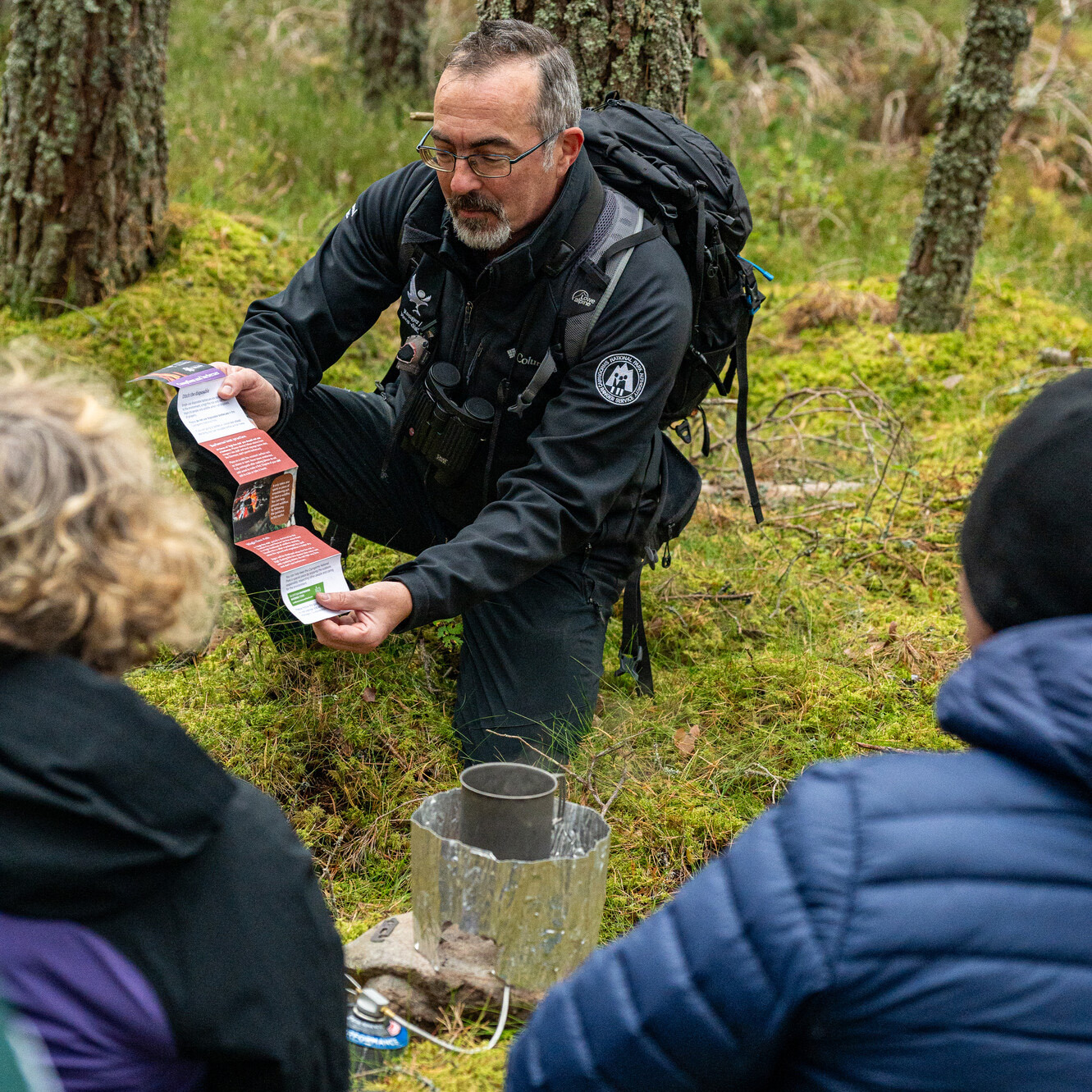
- Direct public engagement — activities promoting responsible behaviour and the Scottish Outdoor Access Code (SOAC) are undertaken by Park Authority access and ranger staff. Details of this engagement are given below for the period April 2025 to March 2026. NB This describes formal dedicated access activity only, so does not include ranger patrolling and informal conversations at other community events.
| Activity | No. of people | No. of sessions | Activities |
|---|---|---|---|
| School groups | 347 | 14 | * Delivery of SOAC education programme to four high schools and one primary school. Additional refresher SOAC camping session before school expeditions. |
| Public events | 244 | 5 | Ranger “pop-up” events (stall in car park on busy day). Ranger attendance at events eg Thrive bike festival. * Two recreation and wildlife presentations to outdoor activity providers (part of Beaver sessions). |
| Continuing Personal Development (CPD) / Training | 28 | 4 | Teacher training session – delivery of SOAC education resource. SOAC training sessions to Park Authority staff, volunteer rangers and partner ranger services. |
| Junior rangers | 29 | 2 | * Wildlife disturbance and creating videos about responsible access. |
| Total number of people directly engaged with | 485 |
Publications — The Park Authority continues to promote the code under the auspices of ‘Tread Lightly in the Park’, the list of tread lightly publications include: a) Main general Tread Lightly leaflet. b) Revised Fire and barbeque leaflet that details the seasonal fire bylaw and responsible behaviour outwith the bylaw period. c) “High Fire Risk” magnetic vehicle signs for all rangers’ vans and partner ranger service vehicles. d) Responsible behaviour poster signs – suite of five poster signs. e) Capercaillie and dogs on lead signs.
Digital promotion — social media – Responsible behaviour messages were promoted on social media (Facebook and Instagram) between March and October on subjects such as responsible dog ownership, wildlife disturbance, wildfire awareness and mushroom foraging. A total of 32 posts ran (58), which achieved 319,120 impressions (156,137), 550 comments (85) and 4,483 reactions (3,661). [2024 figure in brackets].
Post numbers are less than last year as more work was done in partnership with VisitCairngorms who delivered a lot of the visitor management campaign posts. As they are the main local tourism body, the social media followers of VisitCairngorms consist of a high proportion of visitors to the Park, who are a key target audience for much of the responsible behaviour messaging.
Duty to uphold access rights
The current record shows a slight decrease in Section 14 casework (obstructions to access rights eg locked gates) for the 12-month period April 2025 to March 2026 versus the previous year. Records for the review period compare as follows: a) 2025⁄26 – 15 cases (five currently live for 2026⁄27) b) 2024⁄25 — 26 cases c) 2023⁄24 — 33 cases d) 2022⁄23 — 28 cases
Breakdown of cases by area and type: a) Of the 15 access obstruction cases received 01 April 2025 to 01 April 2026:
i. 10 locked gates / barriers
ii. Two obstructive signage
iii. Two obstructive behaviour
iv. One other access restriction
The number of cases reported are significantly higher in Badenoch and Strathspey compared to the other areas within National Park. This is likely to reflect a higher population and greater visitor numbers rather than any behavioural differences.
Core Paths Plan
Taking direction both from ministers and from the Active Cairngorms Action Plan the Access Team are undertaking a review of the Core Paths Plan. The public were invited to comment on these amendments via an informal consultation that ran over three months from the 29 May to 31 August 2025. All the feedback and comments received during the informal consultation have been reviewed and assessed by the Access team, with the LOAF consulted as required. The Board considered the findings of this informal review on 27 March 2026 and approved the move to formal consultation. Formal-Board-Paper-4-Core-Paths-Plan-review.pdf
The formal 12-week consultation on the amended Core Paths Plan commenced on 26 of May and will be completed by 21 of August. Landowners with new or amended core paths have been notified and key statutory consultees invited to make representations.
LOAF
The Cairngorms LOAF had been operational for 21 years on the 31 March 2026 and has played a crucial role in helping the Park Authority shape and develop policies and plans, address access issues and advise on the sustainable management of outdoor access. Members time and dedication is highly valued by the Park Authority and by the Park Authority Board.
The LOAF met three times in 2025⁄26 and covered topics as wide ranging as: b) Drones and Events Guidance c) Outdoor access casework d) Core Paths Planning
The LOAF operating procedures state there will be a maximum of 15 members including one Park Authority board member. Currently there are nine members, three existing members have served in excess of six years and will be standing down over the year, so additional recruitment will be taking place to ensure continuity and representation. The Convener has severed his full six-year term and elections were held at the March 2026 meeting. No volunteers came forward so proposals are going to the June 2026 meeting for the next steps.
Conclusions: Performance Overview
- There are no matters of strategic significance which merit escalation at this time in the opinion of senior managers leading the Park Authority’s delivery of statutory duties. Casework handling capacity and procedures have proven resilient to fluctuations in numbers and types of issues overall although any sustained upward trend requires monitoring in respect of staff capacity.
Adam Streeter-Smith 28 May 2025 adamstreetersmith@cairngorms.co.uk
Colin Simpson 28 May 2025 colinsimpson@cairngorms.co.uk