

Estates in the National Park providing a boost for twinflower conservation
Estates in the National Park providing a boost for twinflower conservation
A delicate and rare plant is the focus of conservation efforts in eastern areas of the Cairngorms National Park. Populations of twinflower – a woodland-floor plant confined to isolated sites primarily in the north-east of Scotland – are at risk due to habitat fragmentation.
Plantlife Scotland and the East Cairngorms Moorland Partnership – a group of six estates, including recently joined Abergeldie Estate, and the Cairngorms National Park Authority – are working to ensure that this relic of the Ice Age can thrive in the future.
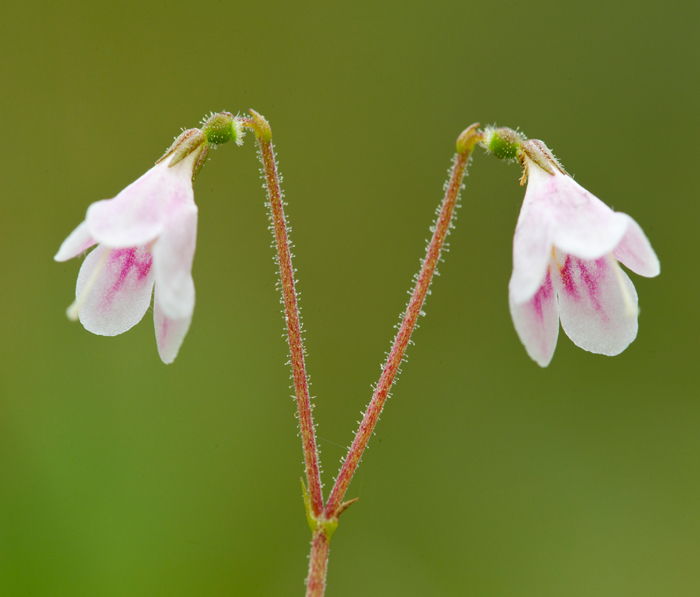
The plant is identified by its two pink bell-like flowers on a slender stem and below, thicker stems, with pairs of tiny, round evergreen leaves, which creep along the ground, forming small mats of twinflower. Habitat loss and changes in the way that woodlands are managed are thought to have resulted in a reduction in twinflower since the 1930s, so that it is now only found in around 50 sites.
As woodlands have become more fragmented, so the gaps between patches of twinflower have grown, becoming too great for insects to be able to cross-pollinate the flowers. This prevents seed production meaning that individual twinflower colonies are clones and lack the genetic variation to be adaptable to changing conditions. Translocation of plants between colonies is a technique which aims to improve connectivity and restore seed production, enabling populations to spread and recolonise suitable habitats via seed dispersal.
Mar Lodge Estate, owned by the National Trust for Scotland, is one of the estates that make up the East Cairngorms Moorlands Partnership. Over the last three years, they have established six new twinflower populations, with eight different clones each, and are augmenting existing colonies with new clones, to increase their genetic diversity, using donor material from elsewhere on Mar Lodge and neighbouring estates.
Their Conservation Manager, Shaila Rao, said: “It is fantastic to be working together to give this charismatic pinewood species a lifeline. We reached an important milestone last year when translocated plants flowered for the first time on the estate and hopefully as the woodland expands, twinflower will be able to flourish alongside.”
Twinflower – or Linnaea borealis – occurs on five of the East Cairngorms Moorland Partnership estates. As well as Mar Lodge, colonies are present on Abergeldie, Balmoral, Glenlivet, and Mar. Although thought of as a typical pinewood species, twinflower can occur on north facing, partially shaded, slopes. For example, on Mar Estate it is found on the moorland edge in ancient birchwoods. Three of the Mar colonies were surveyed in Spring 2022, with two found to be suitable donor sites, having spread significantly since the last survey in 2011.
Cuttings from Mar and other donor sites including Balmoral, Mar Lodge and Abergeldie have been collected to establish a Deeside twinflower clone bank at Balmoral, which now has 22 different clones. Cuttings are being propagated in the Balmoral Castle gardens for future translocation.
Glyn Jones, Balmoral Estate Head Ranger, said: “We’ve also been managing our existing twinflower patches by controlling bracken, thinning and removing non-native trees and monitoring has shown that these patches are increasing in size.”
Glenlivet Estate is propagating twinflower cuttings from the north and west of the Park for translocation in that area.
Plantlife Scotland Project Manager, Sam Jones commented: “We’ve been glad to aid these estates in their keen support for such a beautiful and, sadly, declining pinewood plant. With increasing attention being drawn to the unique and precious nature of Scotland’s Caledonia pinewoods, we will continue to see the recovery of twinflower and the reconnection of long isolated populations. Translocations follow the Scottish Code for Conservation Translocations and, where they take place on designated sites, are carried out under licence from NatureScot.”
Jos Milner, East Cairngorms Moorlands Project Officer said: “It is really encouraging to see some positive results for twinflower and partnership working across multiple landholdings, with the support of Plantlife Scotland. The sites will be monitored closely in the coming months as the weather warms up and the flowers start to appear. Hopefully, twinflower will once again become a more common sight in our native woodlands.”
Latest from the National Park
Come and meet us!
The Park Authority team will be out and about at events this autumn and winter
Draft Partnership Plan consultation goes live
People living and working in or visiting the National Park asked for feedback on the next Partnership Plan.
Time well spent as we stop to blether about farm realities
The latest column from our Agricultural Adviser - first published in the Press and Journal